
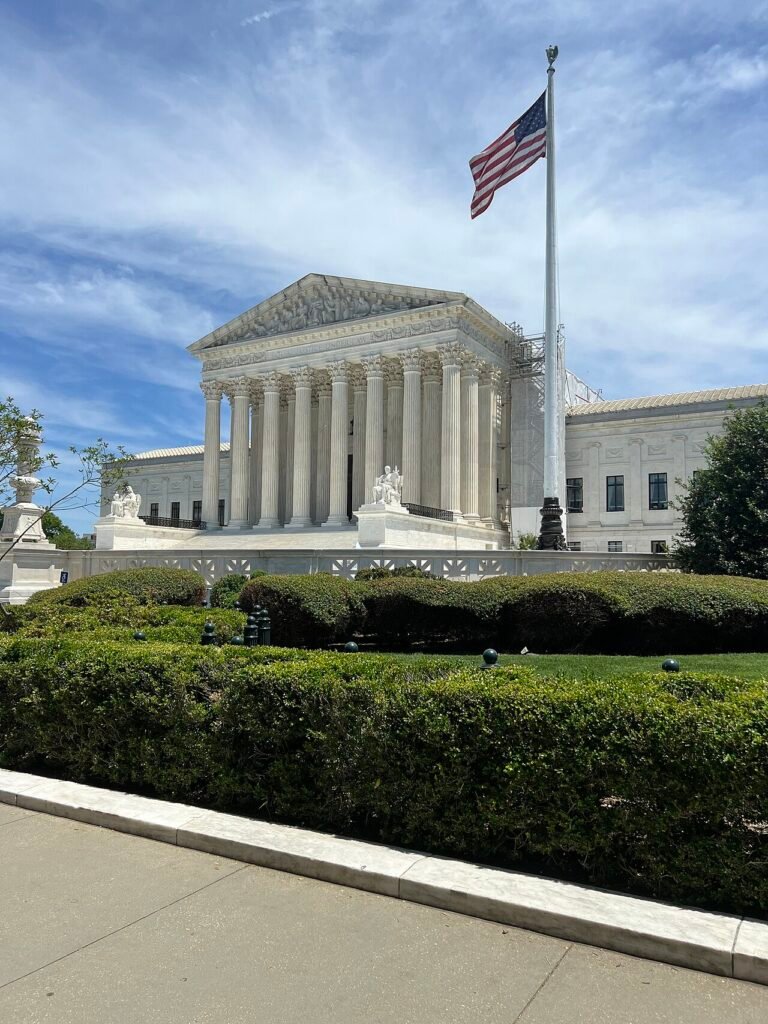
Here is the thing about the Supreme Court these days. The biggest decisions do not always arrive with oral arguments and a fat signed opinion. Sometimes they show up as a short, unsigned order on a Tuesday, and a sitting member of Congress wakes up to find his district might be gone.
That is roughly what happened this week. In a 6-3 order, the justices let Alabama use its Republican-drawn congressional map for the 2026 midterms, freezing a lower court ruling that had thrown the map out for intentional racial discrimination. The reporting came fast from CNN and NPR, and the math underneath it is brutal in its simplicity.
What the Court Actually Did
The order does not settle the case. It does something quieter and, honestly, more consequential for November. It stays the district court’s decision while the appeal plays out, which means the map that Alabama Republicans drew in 2023 is the map voters will use next year.
No reasoning section. No named author. Three liberal justices dissented. That is the whole document. For a ruling that reshapes who controls a House seat, it is a remarkably thin piece of paper.
The Map Math That Decides a Seat
Strip away the legalese and you are left with a redistricting fight over one line on a map. Alabama has seven congressional districts. The 2023 Republican map keeps a single majority-Black district, which in practice gives the state six Republican-leaning seats and one Democratic-leaning one.
The court-ordered map that Alabama actually used in 2024 was different. It carved out two districts where Black voters could realistically elect the candidate of their choice, splitting the delegation roughly five Republicans to two Democrats. CBS News laid out the before and after, and the difference is one seat. That seat belongs to Democratic Rep. Shomari Figures, who represents Alabama’s 2nd Congressional District. Under the reinstated map, his district gets reconfigured, and his path back to Washington gets a lot steeper.
The Purcell Principle Is Doing a Lot of Work Here
If you want the legal hook the majority leaned on, it is something called the Purcell principle. It comes from a 2006 case, Purcell v. Gonzalez, and the idea is straightforward: courts should not change election rules when an election is close, because last-minute changes confuse voters and election officials.
Sounds reasonable on paper. The problem is the timing cuts both ways. The liberal justices pointed out that the map being frozen into place is the one a trial court already found discriminatory. So Purcell ends up protecting the very map that lost at trial. That is the part critics cannot get past.
Sotomayor’s Dissent Did Not Hold Back
Justice Sonia Sotomayor wrote the dissent, and she wrote it like someone who had run out of patience. She said the decision “debases the democratic process” and “corrodes the rule of law by rewarding Alabama’s gamesmanship and outright defiance of court orders.”
She also warned of “a chaotic election, held under a never-before-used congressional map that intentionally discriminates against Black Alabamians.” Read that twice. A justice of the Supreme Court is accusing a state of intentional discrimination and accusing her own colleagues of rewarding it. That is not normal dissent language. That is a flare going up.
How We Got Here
This is not Alabama’s first trip to this exact courtroom over this exact issue. Back in 2023, in Allen v. Milligan, the Supreme Court ruled that Alabama’s congressional map likely violated Section 2 of the Voting Rights Act and effectively told the state to draw a second district where Black voters had a fair shot.
Alabama drew a new map anyway that kept just one such district. A federal district court looked at it, found intentional racial discrimination, and ordered a special master to fix it. That special master map is what got used in 2024. Now the Supreme Court has hit pause on all of that and handed the state’s preferred version back. The Washington Post traced the full back and forth, and it reads like a loop that keeps landing in the same place.
Why This Matters
My read is that this is bigger than one seat in Alabama, even though one seat is exactly what is at stake. The House majority in 2026 could come down to a handful of districts nationwide. Freezing a map that favors Republicans by one seat in a closely divided chamber is not a rounding error. It is leverage.
It also sends a signal to every other state legislature watching. If you can draw an aggressive map, lose at trial, and still run elections under that map for years while the appeals grind on, then the trial loss starts to feel optional. The clock becomes the strategy. That is the precedent that worries people far beyond Alabama’s borders.
What Happens Next
The underlying case is still alive. The Supreme Court froze the lower court ruling, it did not erase it, so there is a full appeal still to come. But appeals move at appeal speed, and elections move at calendar speed. By the time the merits get sorted out, the 2026 midterms will likely already be in the books under the Republican map.
For Shomari Figures, the next year is going to be a grind. For voters in Alabama’s Black Belt, it means heading to the polls under a map a court called discriminatory. And for the rest of us, it is one more reminder that the shadow docket, those short unsigned orders, now decides things that used to demand a full hearing.
USABlaze Takeaway
Look, you can argue the law here in good faith from either side. Purcell is a real doctrine and elections do need stable rules. But there is something hard to swallow about a system where a map can fail at trial for discrimination and still govern an election. The losing side gets to keep playing while the appeal drags. That is the story under the story. Keep your eye on Alabama’s 2nd District next November. It is going to tell us a lot about whether the trial ever really mattered.
Sources: CNN, NPR, CBS News, Washington Post, Georgia Public Broadcasting.
By The USABlaze Editorial Desk