
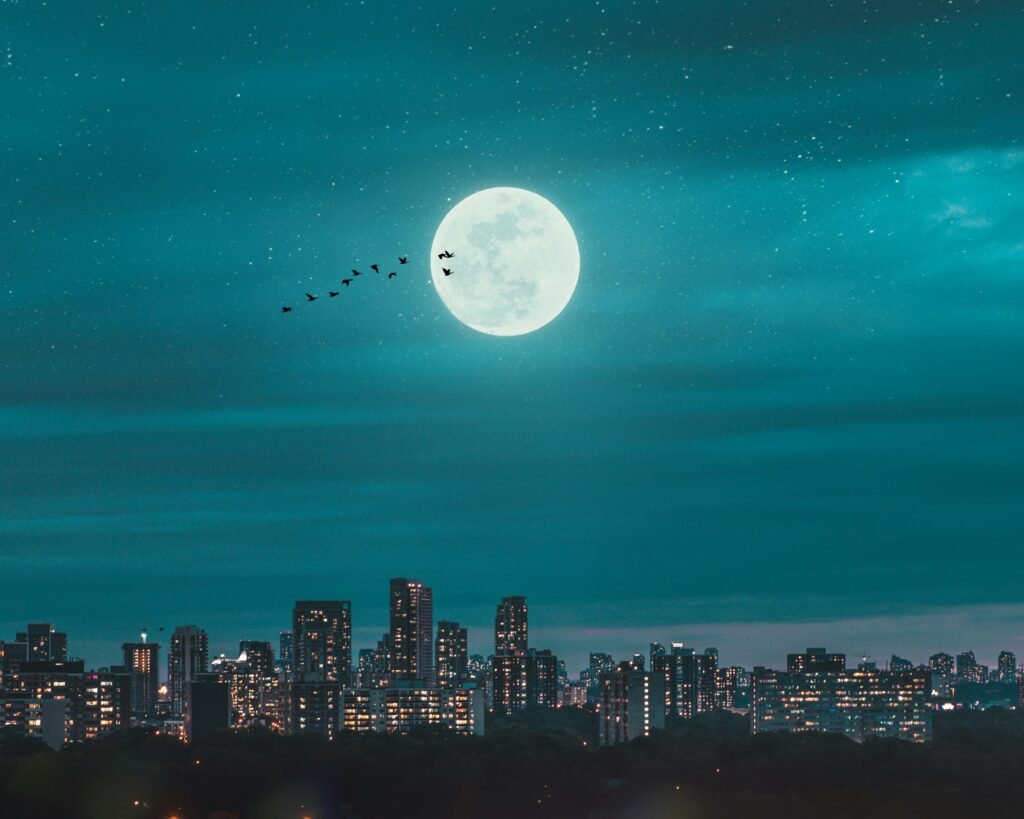
The first full moon of the year did not just rise in the sky it announced itself with a presence that felt impossible to ignore. Known traditionally as the Wolf Moon this celestial event arrived as a massive supermoon illuminating winter skies from the skyscrapers of New York City to the quiet deserts of the Southwest. Reaching its absolute peak in the early hours of Saturday morning the moon offered a rare moment of collective beauty for a nation that often feels too busy to look up. It was the first of three supermoons scheduled for the year setting a spectacular tone for 2026 right out of the gate. For millions of Americans who happened to glance out a window or step onto a balcony the sight of the glowing oversized orb was a sudden reminder of the natural world and its power to stop us in our tracks.
In major metropolitan areas the viewing experience was particularly striking due to the crisp clear weather that dominated much of the country. In New York City early risers were treated to a surreal scene as the supermoon hung low over the Manhattan skyline at five thirty in the morning. The juxtaposition of the ancient cratered satellite against the sharp modern angles of the Empire State Building and One World Trade Center created a visual drama that smartphones struggled to capture but eyes drank in greedily. Meanwhile on the West Coast residents in Los Angeles watched the moon rise over the Griffith Observatory where it appeared to glow with a deep pumpkin orange hue. This stunning color was no accident as explained in the Space.com guide to the January Wolf Moon because the thick atmosphere near the horizon scatters blue light allowing only the warmer red and yellow wavelengths to pass through to our eyes.
The science behind this spectacle is both simple and fascinating. A supermoon is not a term you will find in a dusty astronomy textbook it is a popular label for what scientists call a perigee syzygy. This mouthful of a term simply means the moon is full at the same time it reaches its closest point to Earth in its elliptical orbit. On the night of January second and third our lunar neighbor was roughly 225,130 miles away which is about 13,000 miles closer than average. While that might sound like a minor difference in the vastness of space down here on Earth it translates to a moon that appears about fourteen percent larger and significantly brighter than usual. The result is a flood of moonlight so intense that in rural areas away from city lights people reported seeing their own distinct shadows cast on the ground at midnight.
But the allure of the Wolf Moon goes deeper than just orbital mechanics because it touches on history and folklore. The name itself is a nod to the deep freezing winters of long ago. As detailed in the historical records of the Old Farmer’s Almanac regarding Wolf Moon folklore the name originated from early Native American and colonial European traditions. It references the time of year when wolves were heard howling outside villages with their calls carrying far over the frozen snow. While we now know wolves howl to communicate with their pack rather than out of hunger the image of a Wolf Moon persists because it perfectly captures the mood of January being cold stark and hauntingly beautiful. Other cultures have their own names for this time such as the Center Moon of the Assiniboine people marking the midpoint of winter or the Severe Moon which is a testament to the biting temperatures.
Adding to the magic of this specific event was a cosmic guest star that many observers might have missed if they did not know where to look. As the Wolf Supermoon climbed higher into the night sky it was joined by Jupiter the largest planet in our solar system. The gas giant appeared as a brilliant unblinking star just a few degrees away from the moon creating a dazzling cosmic duo visible even through the light pollution of cities like Chicago and Boston. For those lucky enough to have a pair of binoculars lying around the view was even more rewarding. A quick look revealed not just the craters of the moon in high definition but also the four largest moons of Jupiter strung out in a line like tiny diamonds. It was a rare opportunity to see two of the most dominant objects in our solar system sharing the same patch of sky.
However nature always demands a trade off and this week was no exception. The brilliance of the Wolf Supermoon coincided almost perfectly with the peak of the Quadrantid meteor shower. Typically the Quadrantids are one of the most reliable firework shows of the year capable of producing over one hundred meteors per hour. But the overwhelming glare of the supermoon acted like a natural floodlight washing out all but the very brightest fireballs. While dedicated meteor hunters may have grumbled as they set up their cameras in the cold the general public did not seem to mind at all. The moon is democratic because it does not require patience or luck to see. It is simply there massive and undeniable for anyone who chooses to look up.
For those who missed the peak viewing hours the show is not entirely over yet. The moon will appear full to the naked eye for about three days lingering in the sky like a guest who does not want to leave the party. The visual impact is often best appreciated at moonrise or moonset thanks to the famous Moon Illusion. This is a trick of the brain that makes the moon look absolutely gigantic when it is near the horizon framed by trees or buildings compared to when it is high overhead. Residents in Denver and Seattle took full advantage of this snapping photos of the moon looming over mountain ranges and cityscapes creating images that look almost photoshopped in their scale.
The gravitational pull of the supermoon also makes its presence felt on the oceans. Because the moon is closer to Earth its tidal force is stronger resulting in what are known as perigean spring tides. Coastal communities often see higher than average high tides during these events. While this usually does not cause major problems it can lead to minor nuisance flooding in low lying areas especially if there is a storm surge. It serves as a gentle reminder that the moon is not just a decoration in the sky but a physical force that tugs on our planet every single day.
Looking ahead 2026 promises to be a memorable year for skywatchers. Following this January event there will be a long pause before the next supermoon graces our skies. The calendar dictates that we will not see another full supermoon until November twenty fourth followed quickly by a third and final one on December twenty third. This makes the January Wolf Moon a unique bookend being a bright hopeful start to the year that will not be repeated until the holiday season returns. In the meantime we can look forward to other full moons with equally evocative names like the Snow Moon coming in February and the Worm Moon in March though neither will boast the same super statistics as the spectacle we just witnessed.
Ultimately the Wolf Supermoon of 2026 served as a gentle but powerful anchor in a chaotic world. In an era where our attention is constantly fractured by digital notifications breaking news and endless scrolling the simple act of looking up at the night sky remains one of the few universal human experiences. Whether viewed from a rooftop in Brooklyn a beach in Miami or a quiet farm in Iowa the moon offered a moment of stillness. It rose exactly when physics said it would moved exactly as it has for billions of years and shone with a beauty that has inspired poets and dreamers since the beginning of time. For a few nights in January the Wolf Moon demanded nothing from us but our attention and in return it gave us a glimpse of the timeless clockwork of the universe.